
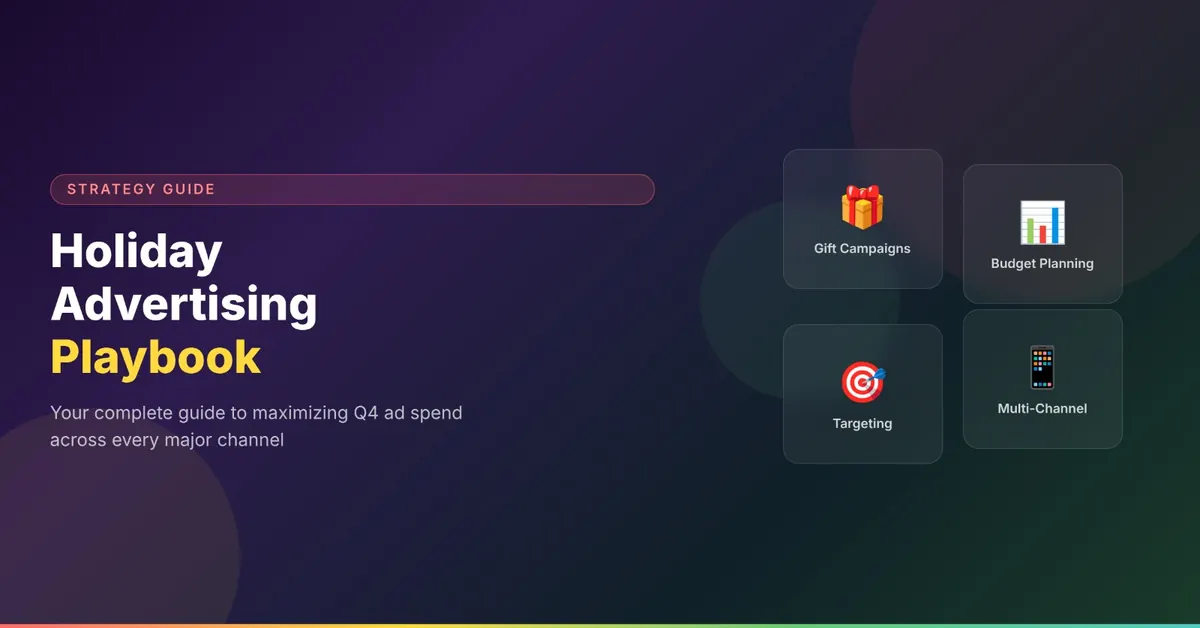
The holiday season is the Super Bowl of digital advertising. In 2026, US holiday retail sales are projected to reach $1.41 trillion, with roughly $304 billion coming from e-commerce alone. For brands and agencies managing large-scale campaigns, the difference between a record-breaking Q4 and a disappointing one often comes down to planning, execution, and operational readiness.
This playbook breaks down everything you need to build, launch, and optimize holiday advertising campaigns across channels – from programmatic display to CTV, paid social, and email. Whether you manage campaigns in-house or work with an outsourced ad operations partner, the strategies here will help you capture demand at every stage of the holiday funnel.
Why Holiday Advertising Demands a Different Approach
Holiday advertising is not simply “regular advertising with bigger budgets.” The dynamics shift in three critical ways:
Competition intensifies. CPMs rise anywhere from 30% to 200% above October levels during peak holiday periods, according to Smartly’s 2025 platform data. Every brand is bidding for the same audiences at the same time, which means inefficient campaigns waste budget faster than they would in any other quarter.
Shopping behavior fragments. Consumers no longer follow a single path to purchase. According to a 2025 Deloitte survey, 59% of shoppers planned to use social media for holiday discovery, while 33% said they would use generative AI tools like ChatGPT for product research – more than double the prior year. Meanwhile, 54% of consumers split their holiday shopping between online and physical stores (McKinsey ConsumerWise).
The window keeps expanding. The old model of a Black Friday kickoff is outdated. Data from the National Retail Federation shows that 71% of US adults now plan to buy gifts before Black Friday, with 46% starting before November. At the other end, 70% of US consumers continue shopping the week after Christmas.
For ad operations teams, these shifts mean more campaign variations, longer flight dates, more platforms to manage, and tighter performance targets – all happening simultaneously.
The Four Phases of Holiday Advertising
The most effective holiday campaigns do not treat the season as a single event. Instead, they operate across four distinct phases, each with its own objectives, messaging, and channel mix.
Phase 1: Early Awareness (September – Mid-October)
Objective: Build brand awareness and capture early-stage intent
The early phase is about getting in front of consumers before the competitive noise ramps up. CPMs are still relatively low, making it the most cost-efficient window for upper-funnel tactics.
Key tactics:
- Launch prospecting campaigns on programmatic display and native channels
- Run CTV campaigns focused on product discovery and brand storytelling
- Build and segment audience pools using first-party data, lookalike modeling, and contextual targeting
- Begin email list warming with early-access previews and holiday gift guides
- Set up retargeting pixels and conversion tracking across all platforms
Phase 2: Consideration and Deal Priming (Mid-October – Mid-November)
Objective: Move early researchers toward purchase intent
This is where messaging shifts from “discover our brand” to “here is why we are the right choice.” Consumers are actively researching, comparing, and building wish lists.
Key tactics:
- Shift budget toward mid-funnel programmatic campaigns with contextual targeting for gift-related content
- Launch paid social campaigns on Meta, TikTok, and Snapchat featuring product comparisons, reviews, and UGC
- Deploy email sequences with personalized product recommendations based on browsing behavior
- Run DOOH campaigns in high-traffic shopping areas to reinforce digital messaging
- Begin A/B testing ad creative, landing pages, and offers to identify top performers before the peak
Phase 3: Peak Conversion (Thanksgiving Week – Cyber Monday)
Objective: Maximize conversions during the highest-intent window
The five-day stretch from Thanksgiving through Cyber Monday – known as the Cyber Five – is projected to generate more than $50 billion in e-commerce sales for the first time in 2026. CPMs spike, but so does purchase intent, making this the window where every dollar must work its hardest.
Key tactics:
- Shift 40-50% of total holiday budget to this window
- Run aggressive retargeting campaigns targeting cart abandoners, product page viewers, and email openers
- Use dynamic creative optimization (DCO) to serve personalized ads at scale – DCO has been linked to 32% higher click-through rates and 56% lower cost per click
- Deploy countdown messaging and urgency-driven creative across all channels
- Monitor campaigns hourly and adjust bids, budgets, and creative in real time
- Coordinate email sends with flash sale schedules for maximum impact
Phase 4: Post-Peak and Extended Holiday (December – Early January)
Objective: Capture late-season demand and build loyalty for Q1
The holiday season does not end on Cyber Monday. December is when last-minute shoppers, gift card recipients, and post-holiday bargain hunters enter the picture.
Key tactics:
- Shift messaging from deals to convenience and delivery guarantees (expedited shipping, in-store pickup)
- Launch gift card and digital gift campaigns for the December 15-24 window
- Run Boxing Day and New Year campaigns targeting deal-conscious shoppers
- Use post-purchase email sequences to convert one-time holiday buyers into repeat customers
- Begin analyzing campaign performance data to inform Q1 strategy and “Q5” advertising (the period between Christmas and mid-January that many advertisers overlook)
Channel-by-Channel Holiday Strategies
Programmatic Display and Native
Programmatic remains the backbone of holiday advertising for most brands, offering scale, targeting precision, and real-time optimization.
Best practices:
- Use contextual targeting to reach consumers browsing gift guides, product reviews, and holiday content
- Layer first-party data with third-party audiences for precision prospecting
- Set frequency caps to avoid ad fatigue during the high-exposure holiday period
- Use private marketplace (PMP) deals to secure premium inventory on key publisher sites before CPMs spike
- Monitor viewability and brand safety closely, as holiday content adjacency risks increase
Paid Social (Meta, TikTok, Snapchat)
Social platforms are where holiday discovery happens. Fifty-seven percent of US consumers use social media to discover new products (Deloitte), and 41% of Gen Z shoppers rely on social platforms for gift ideas.
Best practices:
- Front-load prospecting budgets in October and early November when CPMs are lower
- Use Spark Ads on TikTok and Advantage+ on Meta to amplify organic content that is already performing
- Create platform-specific creative – vertical video for TikTok and Reels, carousel for Instagram, collection ads for Meta
- Use creator partnerships for authentic product recommendations
- Set up conversion API tracking to maintain signal accuracy as privacy restrictions continue tightening
Connected TV (CTV)
CTV is emerging as a performance channel for holiday advertising, not just a brand awareness tool. Research shows that 59% of holiday shoppers say CTV ads guide their purchase decisions, and 36% get gift ideas directly from streaming ads.
Best practices:
- Use CTV to drive incremental reach beyond linear TV and social audiences
- Target cord-cutters and streaming-first households with holiday-specific creative
- Run QR code overlays for direct response
- Coordinate CTV flights with digital retargeting to create a full-funnel sequence
- Leverage free ad-supported streaming (FAST) channels for cost-efficient reach
Email Marketing
Email remains one of the highest-ROI channels during the holiday season, particularly for existing customer re-engagement.
Best practices:
- Segment lists by purchase history, engagement level, and browsing behavior
- Build a holiday email calendar with specific sends for early access, Black Friday, Cyber Monday, last-minute gifts, and post-holiday
- Use dynamic content blocks to personalize product recommendations
- Test subject lines and send times in October before the November rush
- Set up automated cart abandonment sequences with holiday-specific messaging
Digital Out-of-Home (DOOH)
DOOH adds a physical-world touchpoint to digital campaigns, reinforcing awareness near retail locations and in high-traffic areas.
Best practices:
- Use geo-targeted DOOH near malls, transit hubs, and retail districts
- Coordinate DOOH creative with your digital campaigns for consistent messaging
- Run dayparted campaigns to reach commuters in the morning and shoppers in the afternoon
- Use programmatic DOOH platforms to adjust messaging in real time based on weather, inventory levels, or time-sensitive promotions
Holiday Advertising Budget Allocation Framework
Budget allocation varies by business model, but here is a general framework for a full-funnel holiday campaign:
| Phase | Timing | % of Budget | Primary Channels | Objective |
|---|---|---|---|---|
| Early Awareness | Sep – Mid-Oct | 15-20% | CTV, Programmatic Display, Email | Build awareness, seed audiences |
| Consideration | Mid-Oct – Mid-Nov | 20-25% | Paid Social, Native, DOOH, Email | Drive engagement, test creative |
| Peak Conversion | Thanksgiving – Cyber Monday | 40-50% | All Channels (retargeting heavy) | Maximize conversions |
| Post-Peak | Dec – Early Jan | 10-15% | Email, Programmatic, Paid Social | Capture late demand, build loyalty |
Key allocation principles:
- Reserve 10-15% of total budget as a flexible pool for real-time optimization during peak
- Allocate at least 20% of paid social budget to creative testing before November
- Plan for CPM increases of 30-100% during Cyber Five and adjust bid strategies accordingly
- Do not forget Q5 (Dec 26 – Jan 15) – CPMs drop significantly while purchase intent remains high
Creative Best Practices for Holiday Campaigns
Start with a creative audit. Review the previous year’s top-performing assets. Identify which formats, messages, and visual styles drove the best results.
Build modular creative. Create assets that can be easily adapted across formats (16:9 for CTV, 9:16 for social, 300×250 for display) and updated with new offers without rebuilding from scratch.
Match messaging to the phase. Early season creative should focus on inspiration and discovery. Peak season creative needs urgency and clear calls to action. Post-peak creative should emphasize convenience and value.
Use video wherever possible. Video consistently outperforms static display across channels. CTV completion rates above 95% are common, and social video drives 2-3x the engagement of static posts.
Localize and personalize. DCO allows you to swap product images, prices, and messaging based on audience segment, location, or even weather conditions.
Measurement and KPIs for Holiday Campaigns
Holiday campaigns require real-time performance tracking. Here are the key metrics to monitor:
| Metric | Why It Matters | Benchmark |
|---|---|---|
| ROAS | Overall campaign efficiency | Varies by industry; 4:1+ for e-commerce |
| CPM | Media cost efficiency | Track week-over-week for spike management |
| CPA | Direct conversion cost | Compare to non-holiday baseline |
| CTR | Creative relevance | 0.5-1.5% for display; 1-3% for social |
| CTV Completion Rate | Video engagement | 90%+ |
| Cart Abandonment Rate | Conversion friction | Industry avg ~70%; lower is better |
| Email Open Rate | List health and subject line effectiveness | 20-25% for holiday sends |
| Incremental Reach | Audience expansion | CTV and DOOH contribution |
Set up daily reporting dashboards that track spend pacing, performance by channel, and creative fatigue indicators. During peak periods, shift to hourly monitoring for top-spending campaigns.
Why Brands Outsource Holiday Ad Operations
The operational complexity of holiday campaigns – multiple platforms, frequent creative swaps, real-time bid management, hourly reporting – often exceeds what in-house teams can handle, especially when the holiday season coincides with year-end budget cycles and reduced staffing.
This is where outsourced ad operations partners add the most value:
Scale without hiring. An outsourced team can ramp up campaign management capacity for Q4 without the time and cost of permanent hires.
24/7 monitoring. Holiday campaigns run around the clock, and performance issues at 2 AM on Black Friday cannot wait until morning. Outsourced teams operating across time zones provide continuous coverage.
Platform expertise. Managing campaigns across The Trade Desk, DV360, Meta, TikTok, Snapchat, and CTV platforms requires deep platform-specific knowledge. An experienced ad ops partner brings that expertise across all of them.
Creative production support. The volume of creative variations needed for holiday campaigns – different formats, different offers, different audiences – can overwhelm internal design teams. Outsourced creative services keep the pipeline flowing.
Post-campaign analysis. After the holiday rush, an experienced team can analyze what worked, identify optimization opportunities, and build a playbook for next year.
Frequently Asked Questions
When should I start planning my holiday advertising campaigns?
Ideally, holiday campaign planning should begin in July or August, with media buying and audience building starting in September. The brands that perform best during the Cyber Five are those that have been warming audiences and testing creative for weeks before Black Friday.
How much should I increase my advertising budget for the holidays?
Most brands allocate 25-40% of their annual digital advertising budget to Q4. The exact amount depends on your industry, product seasonality, and growth targets. Plan for CPM increases of 30-100% during peak periods and budget accordingly.
What is Q5 advertising, and why does it matter?
Q5 refers to the period from December 26 through mid-January. It is called Q5 because it behaves like a separate mini-quarter. CPMs drop significantly as many advertisers pause campaigns, but consumer intent remains high as people spend gift cards, make returns, and shop New Year sales. It is one of the most cost-efficient windows of the year.
Which advertising channels work best for holiday campaigns?
The most effective holiday campaigns use a multi-channel approach. Programmatic display and native drive scale. Paid social platforms like Meta and TikTok drive discovery. CTV builds awareness and influences purchase decisions. Email re-engages existing customers. The right mix depends on your audience, budget, and campaign goals.
Should I outsource my holiday ad operations?
If your team is stretched thin during Q4 or if you need to scale campaign management across multiple platforms quickly, outsourcing ad operations can be a smart move. An experienced partner can handle campaign setup, optimization, creative trafficking, and reporting, freeing your internal team to focus on strategy and client relationships.